Introduction
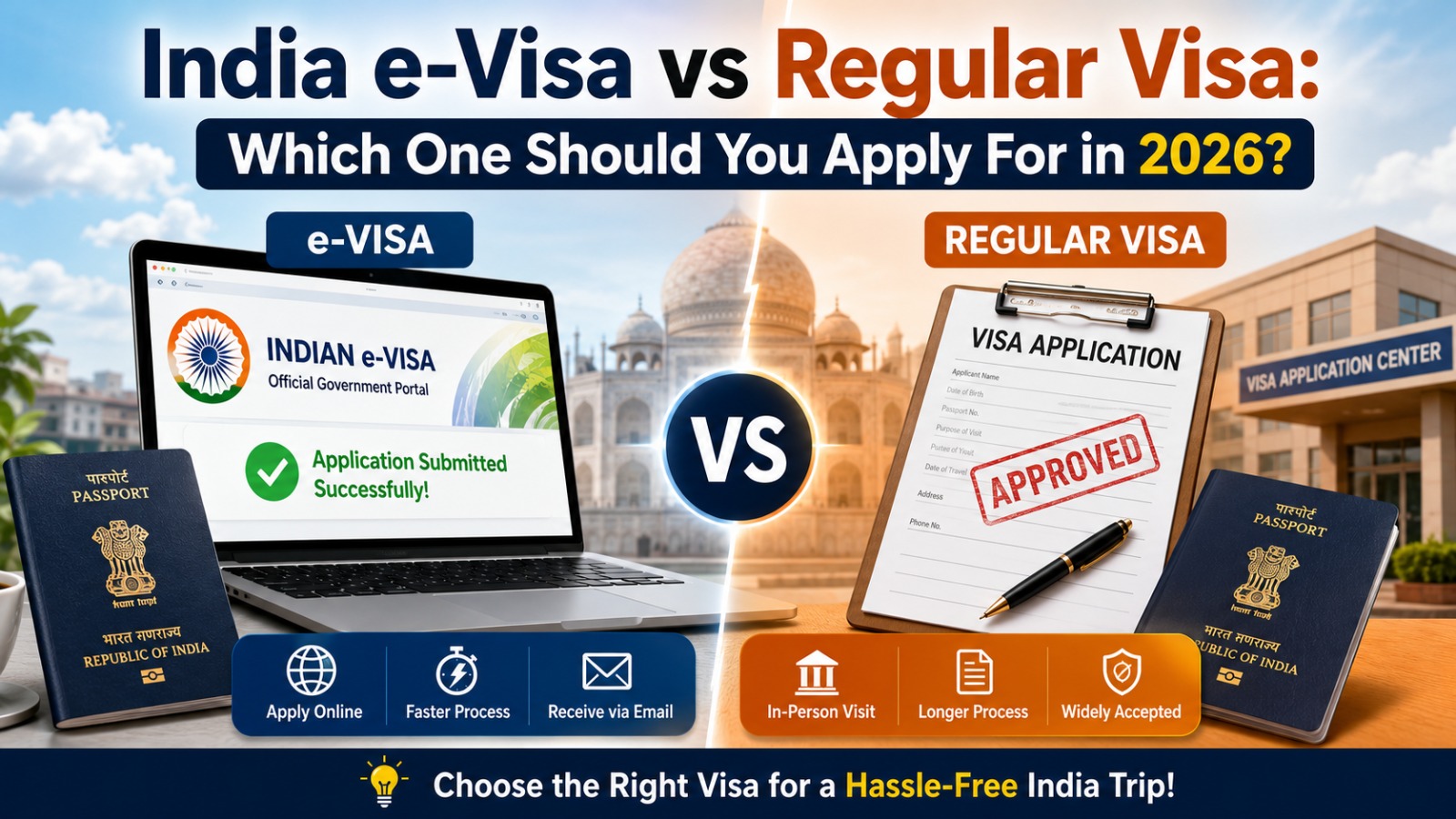
If you are planning a trip to India in 2026, one of the first questions you will face is: should I apply for an India e-Visa or a regular India visa? While both allow you entry into India, they are fundamentally different in terms of the application process, validity, cost, entry limits, and the type of travel they best support.
This guide breaks down everything you need to know about India e-Visa vs regular visa — with a clear comparison so you can make the right choice for your specific travel needs.
What Is an India e-Visa?
The India e-Visa (Electronic Visa) is an online visa authorization issued by the Government of India. It allows eligible foreign nationals to apply for and receive their visa entirely online — no embassy visit, no physical stamp in the passport is required prior to travel.
The e-Visa is electronically linked to your passport and is presented at immigration upon arrival in India. It covers most common travel purposes including tourism, business, medical treatment, wellness (Ayush), and study.
What Is a Regular India Visa (Sticker Visa)?
A regular India visa — also known as a sticker visa or traditional visa — is a physical visa stamp or sticker affixed to your passport by the Indian Embassy or Consulate in your country. It requires you to visit an Indian embassy, submit physical documents, and wait for your passport to be returned with the visa stamp.
Regular visas are typically used for long-term stays, multiple-entry requirements, employment, diplomatic purposes, or in cases where the traveler's nationality does not qualify for an e-Visa.
Key Differences: India e-Visa vs Regular Visa
1. Application Process
e-Visa: 100% online. Fill the form, upload documents, pay the fee, and receive the visa by email. No embassy visit required.
Regular Visa: Requires submitting physical documents at an Indian embassy or consulate, often in person or via a visa courier service. Passport is physically stamped.
2. Processing Time
e-Visa: Typically 3 to 5 business days. Urgent processing available within 1 to 2 days.
Regular Visa: Can take 5 to 15 business days or longer, depending on the consulate workload and visa category.
3. Validity
e-Visa: Varies by category — Tourist e-Visa (30 days, 1 year, or 5 years depending on option chosen); Medical e-Visa (60 days); Business e-Visa (1 year).
Regular Visa: Can be issued for up to 10 years (for US citizens on long-term tourist or business visas) or for the specific duration required.
4. Number of Entries
e-Visa: Tourist e-Visa: Double entry (30-day) or multiple entry (1-year, 5-year). Medical and Ayush e-Visa: Triple entry. Business e-Visa: Multiple entry.
Regular Visa: Can be single, double, or multiple entry depending on the visa type issued.
5. Cost
e-Visa: Generally affordable, ranging from approximately USD 10 to USD 80 depending on visa type and nationality.
Regular Visa: Can be more expensive when including consulate fees, document preparation costs, and courier fees.
6. Ports of Entry
e-Visa: Valid at 28+ designated international airports and 5 major seaports in India. Not valid at land border crossings.
Regular Visa: Valid at all international entry points including airports, land borders, and seaports.
7. Conversion in India
e-Visa: Cannot be converted to another visa type inside India.
Regular Visa: Some categories can be converted or extended in India through the FRRO.
When Should You Choose an India e-Visa?
An India e-Visa is the best choice if:
- You are traveling as a tourist, on business, for medical treatment, or wellness
- You want a fast, convenient, fully online process
- Your travel dates are within the next few weeks
- You are flying into one of India's major international airports
- Your nationality is eligible for the e-Visa (over 160 nationalities qualify)
- You prefer not to visit an embassy or send your passport by mail
When Should You Choose a Regular India Visa?
A regular India visa is more appropriate if:
- You plan to enter India via a land border
- You need a very long-term visa (up to 10 years)
- You are traveling for employment, journalism, research, or other specialized purposes not covered by e-Visa categories
- You require a visa that can be converted or extended while in India
- Your nationality is not eligible for the e-Visa
e-Visa Categories Available in 2026
As of 2026, India offers the following e-Visa categories:
- e-Tourist Visa — for tourism, casual visits, recreation
- e-Business Visa — for business meetings, trade, and commerce
- e-Medical Visa — for receiving medical treatment at recognized hospitals
- e-Medical Attendant Visa — for companions of medical patients
- e-Conference Visa — for attending international conferences
- e-Ayush Visa — for traditional Indian medicine and wellness
- e-Ayush Attendant Visa — for companions of Ayush visa holders
Nationalities Eligible for India e-Visa
Over 160 countries are eligible for the India e-Visa including:
- United States of America
- United Kingdom
- Canada
- Australia
- New Zealand
- Germany, France, Spain, Italy, Netherlands (and most EU nations)
- Japan, South Korea, Singapore
- UAE, Saudi Arabia, Qatar
Nationals of Pakistan, Bangladesh (with exceptions), and a few other countries are not eligible for the e-Visa and must apply through the regular embassy route.
Which Is Faster — e-Visa or Regular Visa?
Without question, the India e-Visa is significantly faster. The e-Visa process involves no physical queuing, no embassy appointments, and no passport mailing. Most applications are processed and approved within 3 to 5 business days — sometimes faster with assisted services.
A regular visa involves scheduling an appointment, visiting the consulate, and waiting for your passport to be physically processed and returned — which can take 1 to 3 weeks.
Final Verdict: e-Visa vs Regular India Visa
For the vast majority of travelers — especially US, UK, and Canadian citizens traveling for tourism, business, medical, or wellness purposes — the India e-Visa is the clear winner. It is faster, cheaper, fully online, and perfectly suited for short to medium-term trips.
Choose the regular visa only if your specific circumstances require it — such as land border entry, very long validity requirements, or specialized visa categories.
Conclusion
Understanding the difference between India e-Visa and regular visa helps you make an informed decision and avoid delays. For most travelers in 2026, the e-Visa route is the smart, efficient, and stress-free way to visit India.
If you need help applying for the right India visa, indianvisaonline.com offers expert assistance for all e-Visa categories — Tourist, Business, Medical, and Ayush.
Apply for your India e-Visa now at indianvisaonline.com — fast, accurate, and fully online. Experts available 9 AM to 9 PM EST.


